

The iconic Etch-a-Sketch, a toy beloved by generations, always had one major limitation: a drawing mistake meant shaking the entire device and starting over from scratch. With the TekkaSketch project, this limitation is overcome thanks to a modern approach that integrates digital functions while preserving the classic aesthetic.
The idea stems from observing the original mechanism of the Etch-a-Sketch: a thin layer of aluminum powder covers the internal screen, and two knobs move a pointer through a pulley system, “displacing” the powder to create drawings. It’s not ink, but rather the absence of powder in specific areas.
During the design phase, the creator considered various solutions to implement an “undo” button, including a micro-vacuum to remove and reposition the powder. However, the mechanical complexity led to exploring alternative routes, inspired by another childhood passion: the video game Snake, in the Nibbles.bas version for 1990s PCs.

The concept of Snake, with continuous movement and progressive growth, was reinterpreted for the Etch-a-Sketch, turning it into a game controller. The first prototypes included the use of augmented reality via smartphone to overlay graphics on the physical drawing, a gear system with rotary encoders, and even fruit illustrations printed on transparencies. While creative, these solutions didn’t fully address interactivity and fluidity limitations.
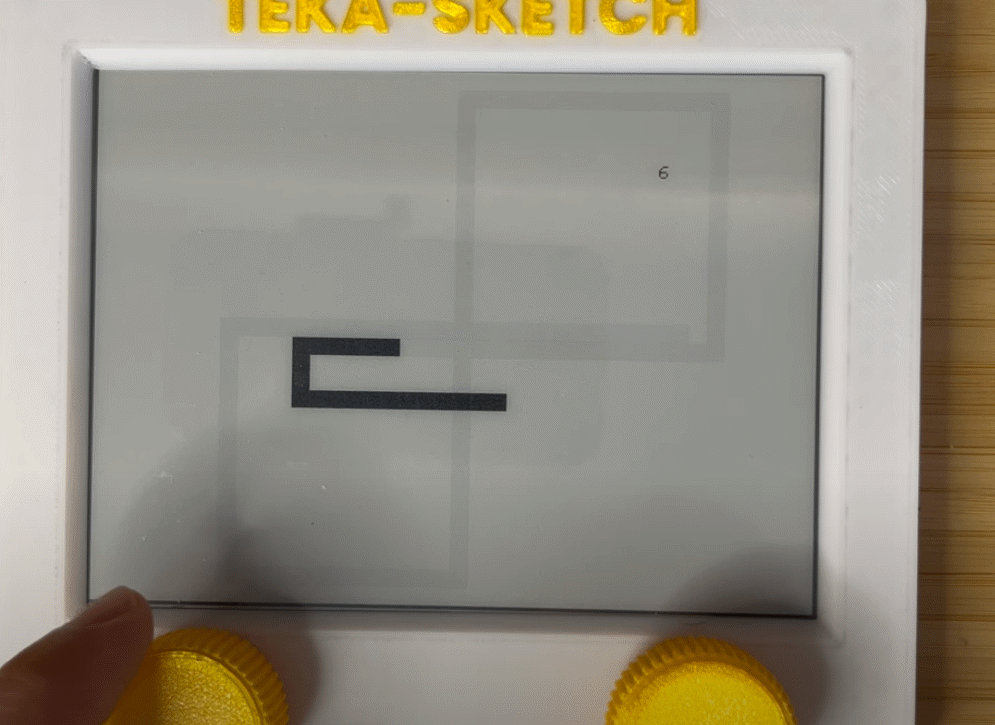
The breakthrough came with the decision to entirely replace the original display with an E-Ink screen, driven by an ESP32 and two rotary encoders in place of the knobs. This setup not only faithfully replicates the Etch-a-Sketch experience but also allows drawings to remain visible even when the device is powered off. The software logic compensates for speed differences between the encoders, ensuring consistent control.
In drawing mode, the E-Ink’s persistence and partial refresh deliver a fluid experience, despite a slight delay typical of this technology. The Snake mode uses a single encoder to control direction, with the continuous movement of the snake adding dynamism. A two-player Snake version was also developed, using both knobs to control two independent snakes.
TekkaSketch represents a blend of nostalgia and innovation, merging analog charm with digital potential. The project showcases how integrating hardware and software can transform an iconic object into a playful and creative platform, ready to support additional games and functionalities in the future.

hi
Seeing the “shake to erase” feature implemented with an actual accelerometer instead of the old physical powder is a great touch that bridges the gap between mechanical and digital. It’s a huge win for durability since you don’t have to worry about internal gears or messy aluminum dust leaking out over time. This is exactly the kind of weekend project that reminds you why we got into tech in the first place—taking a basic concept and making it objectively better using a few well-chosen sensors and some clean code.
TekkaSketch brilliantly proves that the best retro revival isn’t nostalgia, it’s persistence without the mess and the broken parts.
just pure fun with a bonus Snake game.